
AI is earning its place when it helps a customer get an answer or an employee finish a clear job. Look at a question that arrives after closing, a quote request waiting overnight, or a worker trying to resolve an unfamiliar problem. Studies of shopper assistance and staff support show why such gaps are worth testing; they do not establish that adding AI raises every business’s sales.
That distinction matters when the same budget has to cover staff, tools and the work customers already expect. The strongest sales tests found value where help was missing. Faster work is better established than company-wide profit, and some projects never get as far as serving a customer.
For businesses small and large, the useful Q4 decision is to find one gap, test whether AI closes it and keep someone responsible for the result. The evidence below helps make that choice.
Is AI raising sales? In specific jobs, yes.
The strongest sales evidence comes from seven randomized tests inside one large cross-border online marketplace, involving millions of shoppers between September 2023 and June 2024 [1]. The working paper has not yet been peer-reviewed. Two of its five authors consulted for the marketplace, and one worked for it.
Sales rose in three of the five tests with full sales data. The largest gain, 16.3%, came from a chatbot answering shoppers’ questions around the clock before they bought; the comparison group had no pre-sale help. Smarter search added 2.9% and AI-written product descriptions 2.1%, while AI-written marketing messages and ad titles showed no measurable sales lift over people’s versions.

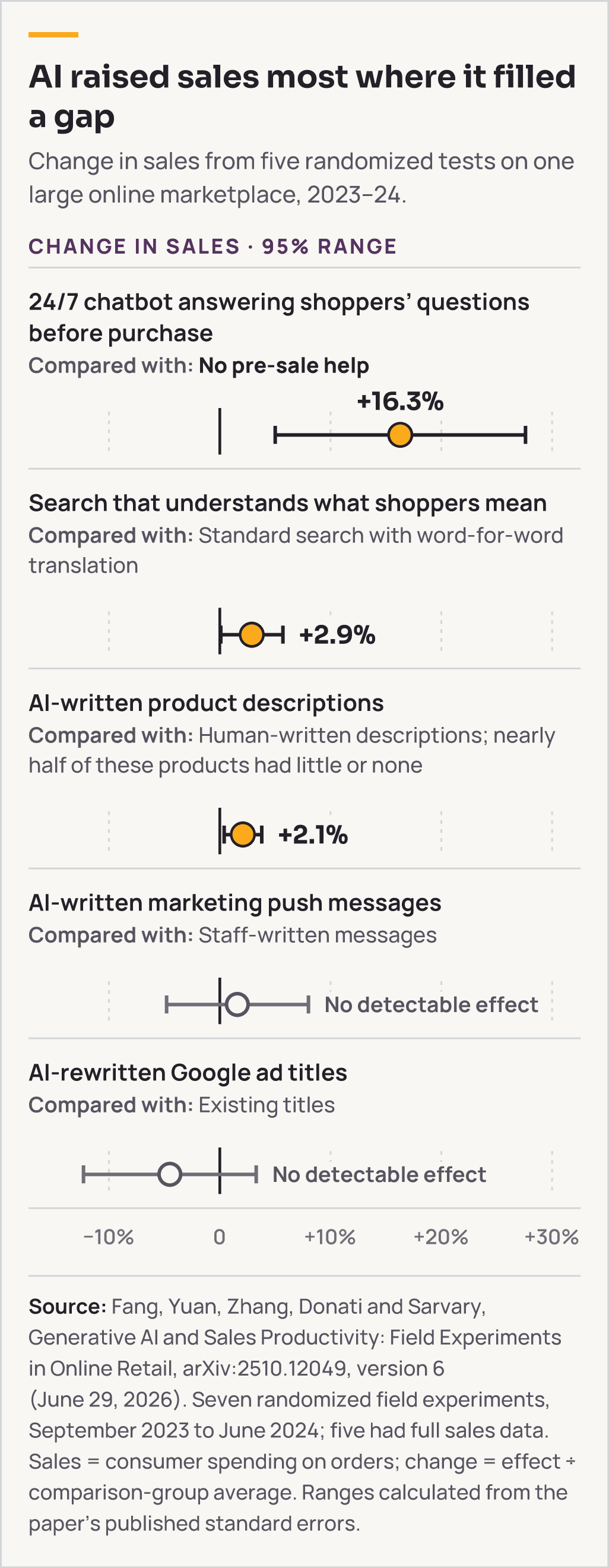
More people bought, rather than buying bigger baskets, and returns and customer ratings did not get worse [1]. The useful lesson is to ask what a customer cannot get from the business today. Those percentages are a reason to test a gap, not a sales forecast for a contractor, restaurant or professional practice.
The useful lesson is to ask what a customer cannot get from the business today.
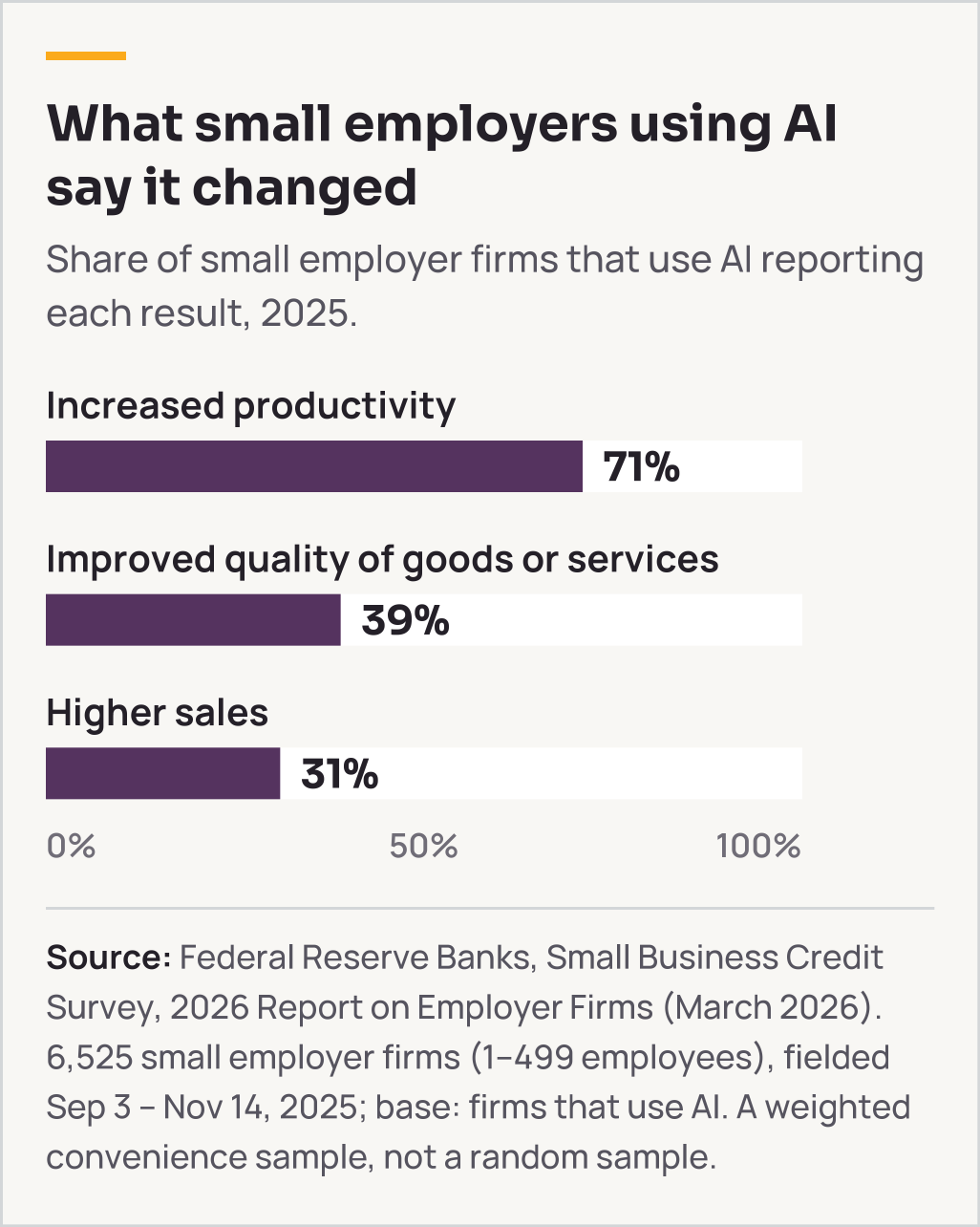
Small employers report a similar distinction between getting work done and selling more. Among those using AI in the Federal Reserve’s 2025 small-business survey, 71% said it increased productivity, 39% reported better quality and 31% reported higher sales [2]. These are businesses’ own reports, not experimental results.

Advice is a different job from answering a product question. In a randomized trial, Kenyan entrepreneurs received a GPT-4 business adviser on WhatsApp; there was no measurable average effect on revenue or profit [3]. Owners already doing well may have benefited, while struggling owners did worse, depending on which advice they followed.
An owner still has to decide whether an answer fits the business, its customers and its costs. That judgment cannot be handed over just because the answer sounds complete.
Company-wide gains remain modest or uneven. In a Federal Reserve and Duke University study of 734 executives, companies credited AI with adding about 0.5% to small firms’ revenue and about 1% to large firms’ revenue in 2025 [4]. Across nearly 6,000 executives in four countries, nine in ten reported no effect on employment or productivity over three years [5]; in McKinsey’s 2026 global survey, 37% of respondents said AI had added at least something to operating profit [6].
These surveys ask different populations different questions. Faster work needs its own measurement before it becomes a claim about the income statement.
Where AI helps the people doing the work.
Useful help can arrive mid-task: an answer during a support conversation, or a colleague’s first draft. The table separates each measured result from sales.
| Use | What was measured | Result | Evidence |
|---|---|---|---|
| Suggesting answers to support staff during live chats | Issues resolved per hour | +15% on average; biggest gains for less experienced and lower-skilled staff; customers more polite | Field study, 5,172 agents [7] |
| Drafting routine writing such as emails, plans and cover letters | Time and quality | 40% less time; 18% higher quality | Randomized test, 453 professionals [8] |
| Realistic consulting tasks within AI’s capabilities | Speed and quality | 25% faster; significantly higher quality | Randomized field experiment, 758 consultants [9] |
| The same consultants, on a task outside AI’s capabilities | Correct answers | 19% less likely to produce a correct solution | Same experiment [9] |
For a team leader, the opportunity is to give less experienced people useful help at the moment they need it. On well-defined tasks, AI helped newer and less practiced workers most, narrowing skill gaps [7] [8]. That is different from asking it to make an open-ended decision about running a business.
Time saved also needs a purpose. Decide whether it will reduce a backlog, free someone for customers or make room for work the team could not get to. Then measure that outcome alongside the time saved.
Where the promise breaks down.
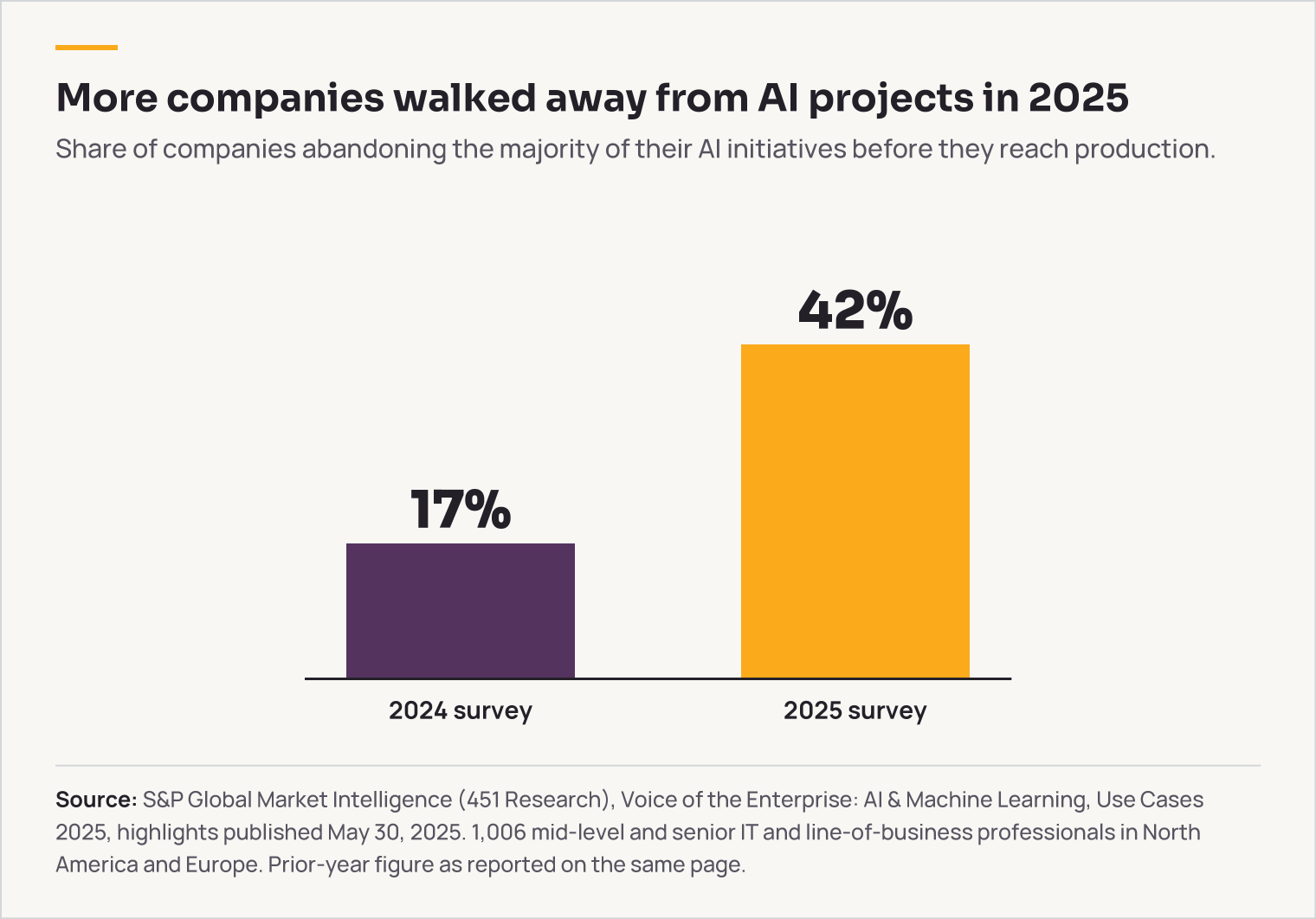
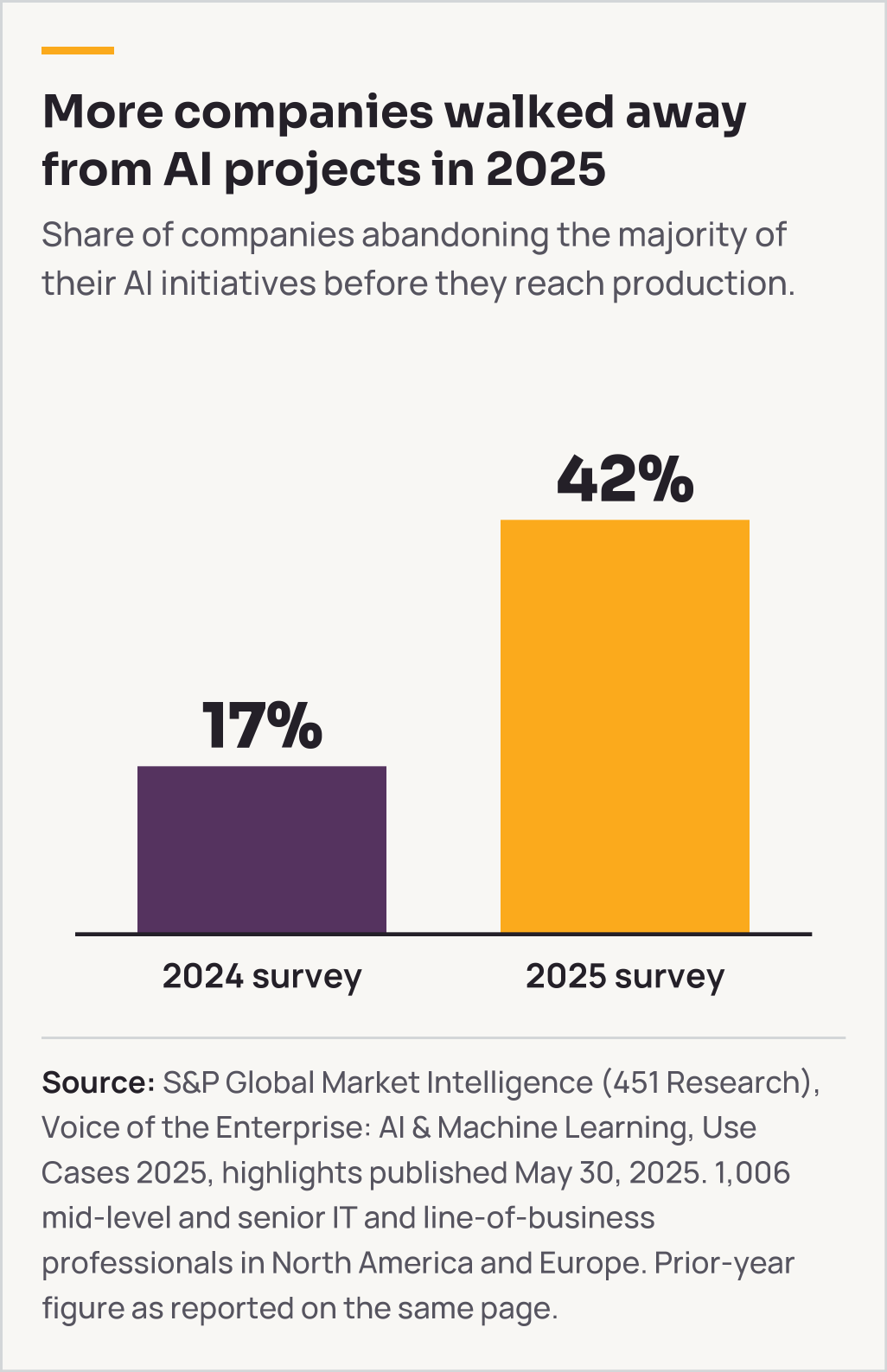
A promising demonstration still has to survive daily work. In S&P Global Market Intelligence’s 2025 survey of 1,006 IT and business professionals, 42% of companies had abandoned most of their AI initiatives before launch, up from 17% a year earlier [10]. In its 2026 survey, respondents said 37% of their AI initiatives were live and delivering value [11].
Customer service shows why speed alone can be a poor target. In a randomized test, an AI agent resolved eligible chats itself while staff supervised; chats got shorter, but customer ratings fell [12]. People rescued technical problems better than conversations with upset customers, and stepping in early mattered. One of the paper’s five authors works for Alibaba Group, which runs the platform tested.
For the customer, a short conversation is not necessarily a resolved problem. For the business, the handover to a person is part of the service, not an exception to design later. Census found that 43.7% of U.S. businesses using AI used it to support an employee’s task, against 10.1% to take one over [13].
The name on the product can be misleading, too. Gartner estimates that only about 130 of the thousands of vendors selling “agentic” AI offer the real thing, and describes “agent washing”: relabeling assistants, automation tools and chatbots [14]. Its prediction that more than 40% of agentic projects will be canceled by the end of 2027 is a forecast, not a measured failure rate.
Ask what the product actually does and who does the work behind it. Regulators have acted publicly against the following claims; the descriptions follow the agencies’ accounts. A settlement is not an admission of wrongdoing.
| What was sold | Company | Agency | The agency’s allegation or finding | Outcome |
|---|---|---|---|---|
| AI services for entrepreneurs and small businesses | Air AI | FTC, 2025–26 | Alleged: false earnings and refund-guarantee claims, and misrepresented services [15] | Settlement announced March 2026 |
| A tool said to make websites accessibility-compliant | accessiBe | FTC, 2025 | Alleged: it could not make every site compliant as claimed, and affiliated reviews looked independent [16] | Final order; $1 million |
| An AI “robot lawyer” | DoNotPay | FTC, 2024–25 | Alleged: it could not substitute for a lawyer as claimed and was never tested against a lawyer’s work [17] | Final order; $193,000 |
| An AI content detector | Workado | FTC, 2025 | Alleged: advertised as 98% accurate; independent testing found 53% on general content [18] | Final order |
| Retail storefronts sold as passive income from “AI-powered tools” | Ascend Ecom | FTC, 2024–25 | Alleged: false claims that its “cutting edge” AI tools would earn passive income [19] | Court order banning business-opportunity marketing; described as proposed in the June release, entered August 11, 2025 |
| Ad targeting said to use conversations overheard by smart devices | Cox Media Group and two other firms | FTC, 2026 | Alleged: the AI-powered service was not based on voice data [20] | Final orders; $930,000 combined |
| AI voice ordering for drive-thrus | Presto Automation | SEC, 2025 | Found: it told investors AI eliminated human order taking, while order takers abroad processed the vast majority of orders [21] | Settled without admitting or denying; no penalty |
A claim about earnings, accuracy or compliance needs evidence for that claim. A polished demonstration does not establish it.
How to put useful AI to work.
1. Start where a customer is waiting.
Look for questions that arrive after hours, quote requests that sit overnight or calls that go to voicemail. The marketplace study supports testing an unanswered need [1]. Choose one gap and define what a satisfactory answer or handover looks like before introducing a tool.
2. Give your people support and a clear handover.
Let AI help staff find an answer, then keep a person one step away [7] [12]. Agree when the conversation must move to someone who can resolve it, especially when a customer is upset. Make that route easy for the customer to use.
3. Review answers that commit the business.
Prices, terms and safety guidance deserve a person’s review. Accuracy was the top challenge small employers using AI reported to the Federal Reserve [2]. In 2024, a Canadian tribunal ordered an airline to compensate a customer misled by its chatbot and rejected the argument that the chatbot was a separate entity [22].
4. Set a baseline and a decision date.
Write down today’s numbers, the result you expect and when you will decide to keep, change or stop the tool. Measure sales, booked work or hours saved, with a comparison group where practical. RAND’s interviews with 65 data scientists and engineers put a misunderstood or poorly communicated problem first among five root causes of failed AI projects [23].
5. Teach the team what to use and what to question.
Among U.S. businesses using AI, only 15.0% trained staff to use it, and 64.3% made no changes to put it to work [13]. Gallup found reported productivity gains rose from 45% among employees using AI in one or two ways to 90% among those using it in seven or more [24]. That association does not show that adding uses causes the gain; pair access with guidance and review.
6. Buy on evidence.
Ask for results from businesses like yours, how they were measured, who actually does the work and what happens if it does not deliver. The FTC warns that an offer promising guaranteed income or a “proven system” is likely a scam [25]. Its fake-reviews rule, in force since October 2024, bans creating or selling fake reviews, including AI-generated ones, and buying them when a business knew or should have known they were fake [26].
| Small business | Larger company | |
|---|---|---|
| First use | One job where customers wait: questions, quote requests or missed calls | One process with a clear before-and-after measure and a comparison group |
| Measure | Inquiries answered, jobs booked and hours saved | Sales, conversion and profit alongside productivity |
| Keep accountable | One person who checks answers and handles exceptions | A named process owner, with staff trained to intervene |
Where AI adoption stands.
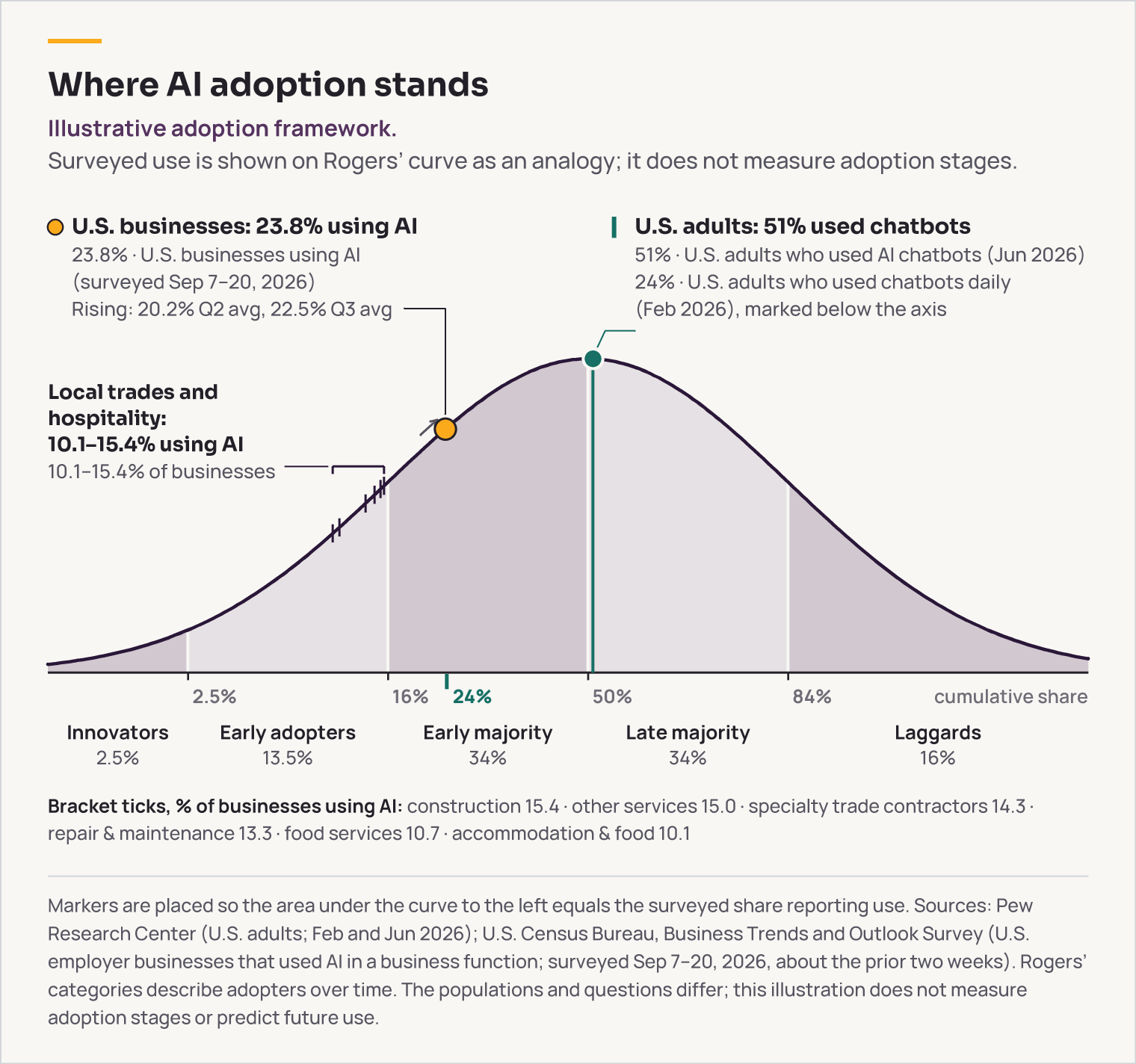
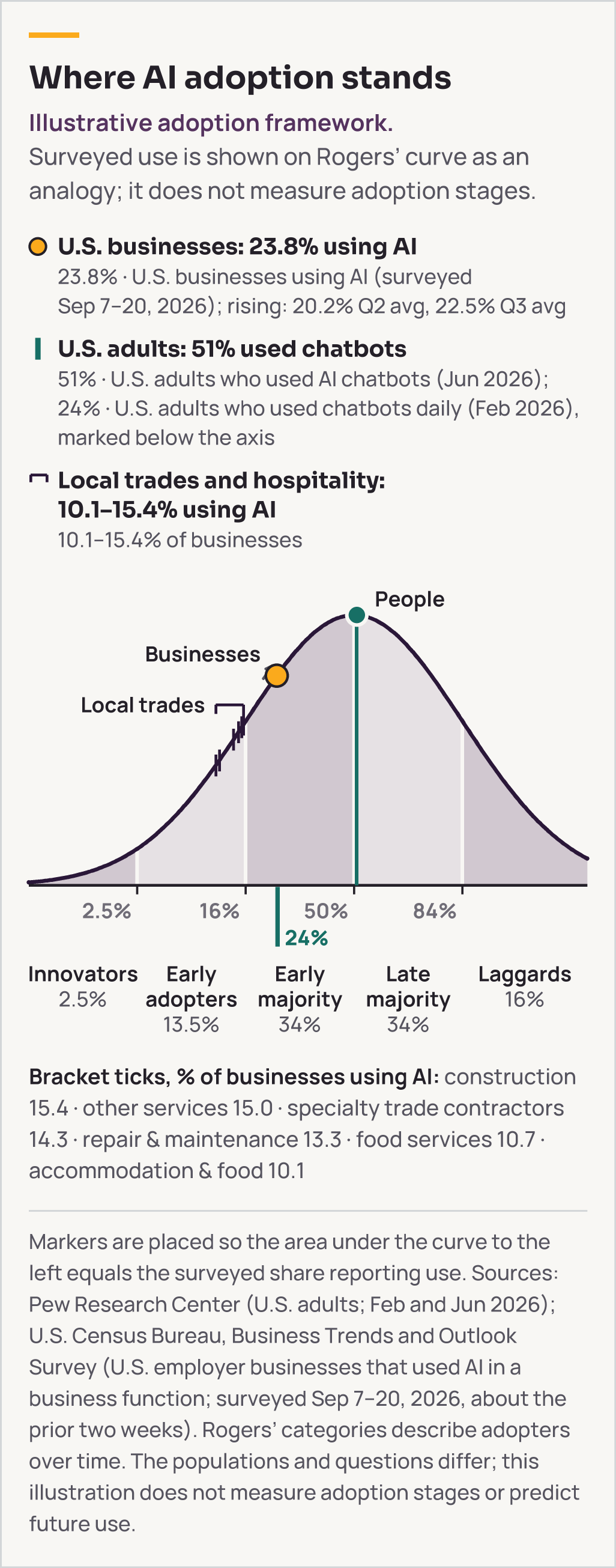
Adoption rates give context for a decision; they do not tell you whether a particular tool will pay for itself. The useful comparison is with the work and customers in your own business, not a deadline to keep up with a national percentage.
| Population | Measure | Share | Source | Time period |
|---|---|---|---|---|
| U.S. adults | Used AI chatbots | 51% | Pew Research Center [27] | Surveyed June 22–28, 2026 |
| U.S. adults | Used AI chatbots daily | 24% | Pew Research Center [28] | Surveyed February 17–23, 2026 |
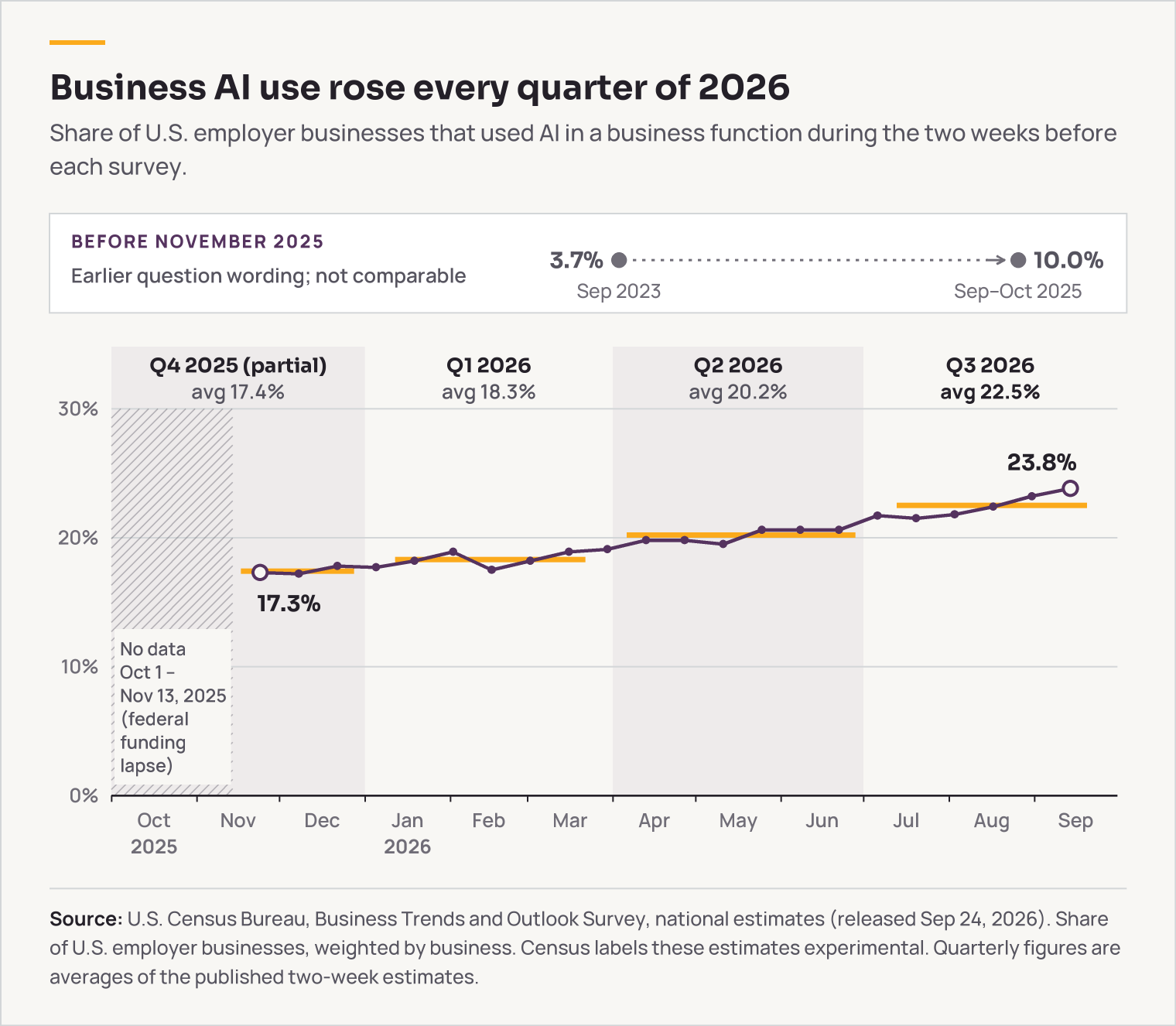
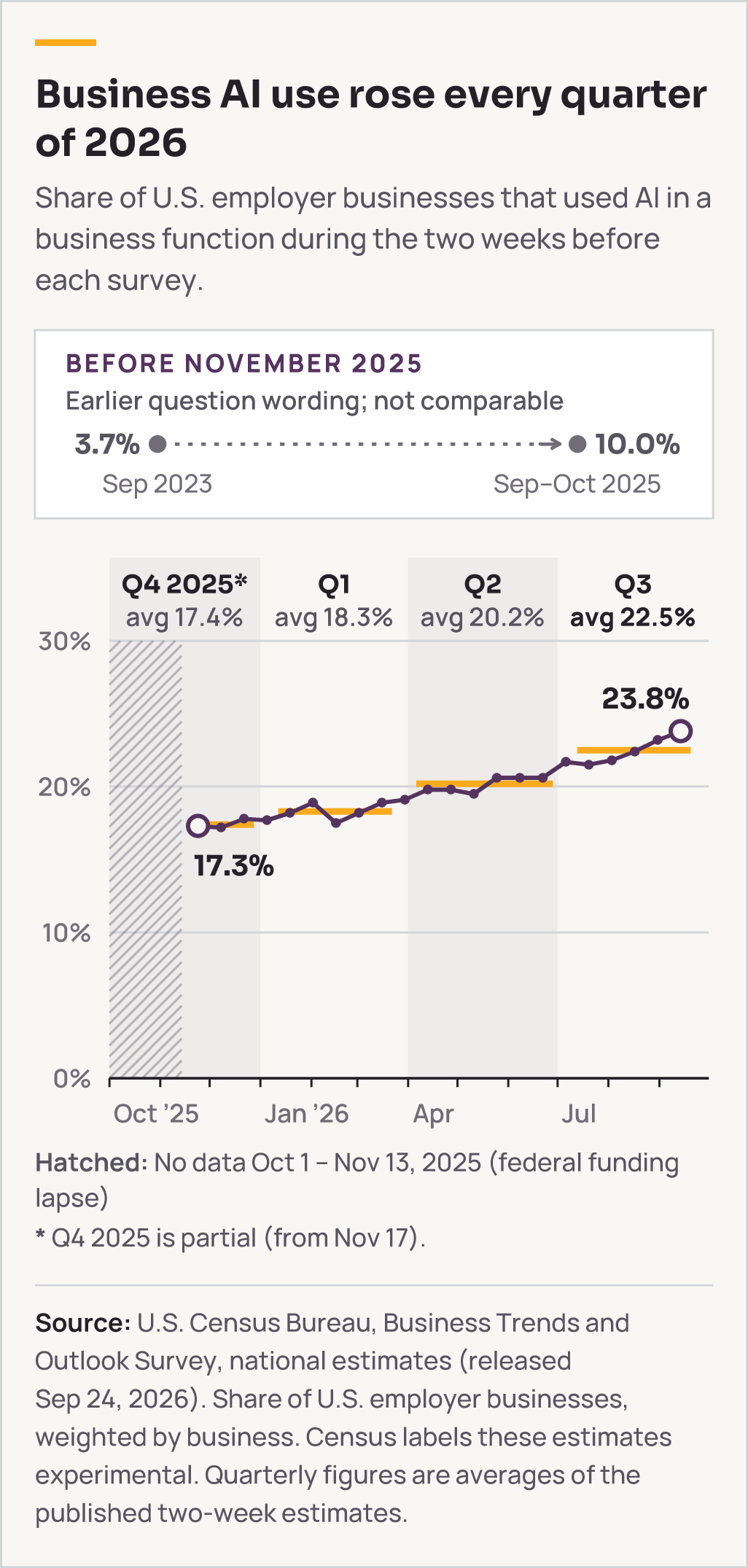
| U.S. employer businesses | Used AI in a business function | 23.8% | U.S. Census Bureau, BTOS [29] | August 24–September 6, 2026; surveyed September 7–20 |
| U.S. employer businesses | Used AI in a business function, averaged by quarter | Q2 20.2%; Q3 22.5% | Same Census series | Averages of published two-week estimates |
| Selected local trades and hospitality sectors | Used AI in a business function | 10.1–15.4% | Same Census survey | August 24–September 6, 2026 |
| Construction | Used AI in a business function | 15.4% | Same Census survey | Same reference period |
| Other services | Used AI in a business function | 15.0% | Same Census survey | Same reference period |
| Specialty trade contractors | Used AI in a business function | 14.3% | Same Census survey | Same reference period |
| Repair and maintenance | Used AI in a business function | 13.3% | Same Census survey | Same reference period |
| Food services | Used AI in a business function | 10.7% | Same Census survey | Same reference period |
| Accommodation and food | Used AI in a business function | 10.1% | Same Census survey | Same reference period |
In Gallup’s Q2 2026 survey, 52% of U.S. employees used AI in their role [24]. Personal familiarity, workplace use and a business return are different measures.
Business use has risen within the Census series. Averaging its two-week estimates, Q3 reached 22.5%, up from 20.2% in Q2—the largest quarterly rise since the current question began in November 2025 [29].
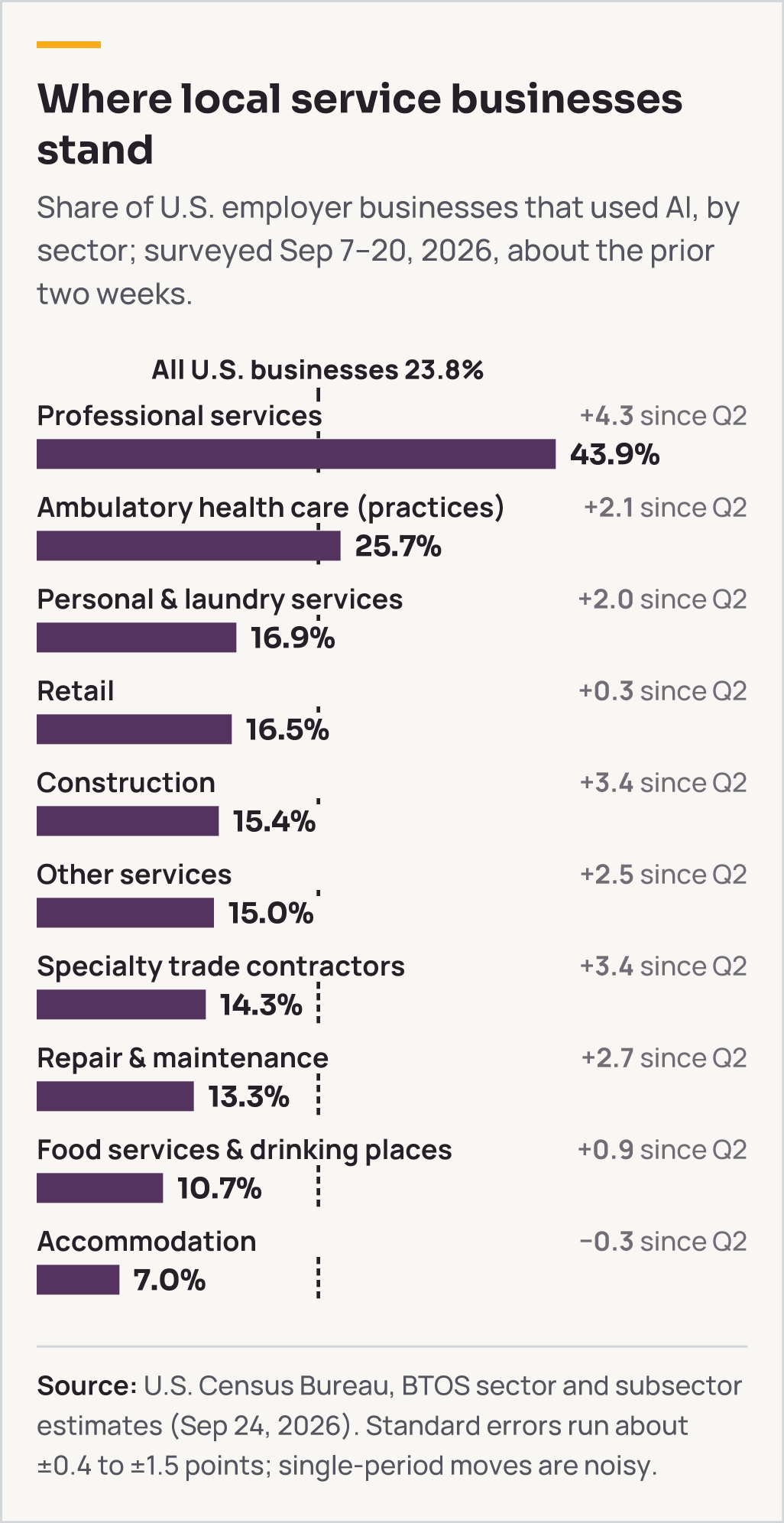
The sector picture is more useful to a local operator than the national average. Construction stood at 15.4%, specialty trade contractors at 14.3%, repair and maintenance at 13.3% and restaurants at 10.7%. Construction and the trades rose fastest among these local sectors in Q3, while restaurants and hotels barely moved [29].
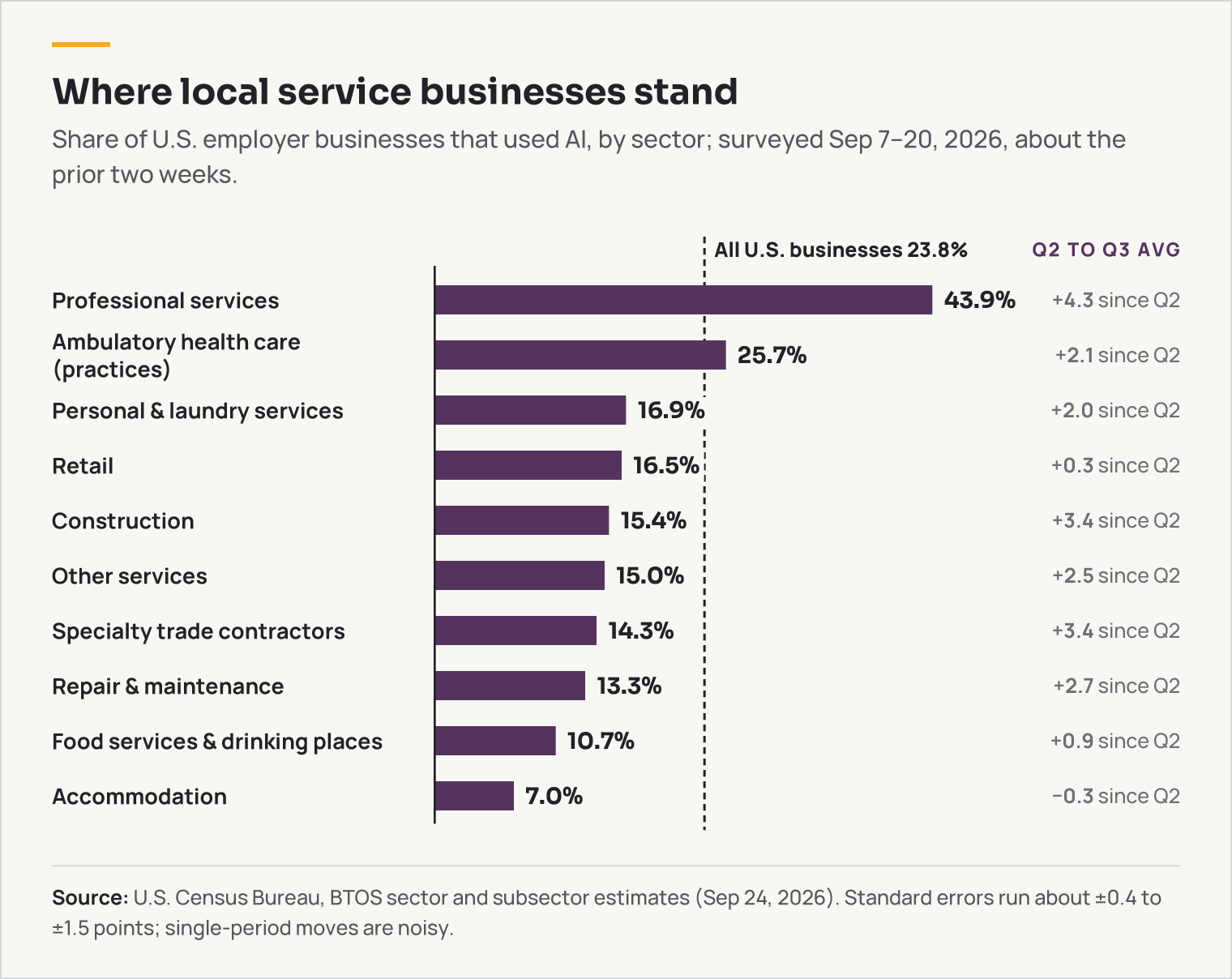
Company size alone does not settle the decision. Businesses with 1–4 employees used AI at about the same rate as those with 20–49 employees, 23.8% against 24.5%; use reached 44.0% at 250 employees or more [29]. Among construction businesses with no plans to use AI, 69.0% said it did not apply to them [13].
A lower usage rate is not proof of a missed sale. A useful next step for a trades business may be improving responses to inquiries rather than changing how the physical work is done; test that choice against a real need.
What changed in Q3.
The changes reaching businesses are practical: AI can take more steps in a browser, advertising and measurement tools are expanding, and new rules affect some markets. The table keeps those developments tied to the customer or business decision they touch.
| Date | What happened | What to consider |
|---|---|---|
| Jul 9 | Google added a “How this ad was made” panel; ads made with its own AI tools are disclosed automatically [30] | Customers can see when AI helped make an ad |
| Jul 30–Aug 26 | Gemini Spark began running web errands in Chrome with permission, using logged-in accounts; Claude in Chrome reached every paid plan [31] [32] | Booking and contact forms may be completed by an agent acting for a customer |
| Aug 2 | Most EU AI Act rules began to apply, including transparency rules [33] | Review requirements if you serve customers in the EU |
| Aug 31 | Search Console’s AI-features report and opt-out reached all websites [34] | A free view of the site’s presence in Google’s AI answers |
| Aug 31 | OpenAI said ChatGPT ads reached a $1 billion annualized revenue run rate, with location targeting [35] | A new paid channel to evaluate against existing acquisition results |
| Sep 8–29 | Meta launched Muse, then Muse for Small Business; the latter cannot publish, send or spend without the owner’s approval [36] [37] | Decide which back-office actions need approval |
| Sep 29 | OpenAI introduced Dots, always-on agents, on Pro and Business Premium plans in eligible markets [38] | Ongoing work still needs a defined task and accountable owner |
| Sep 30 | California signed 13 AI and related-technology bills, including a ban on employers relying only on AI to discipline or fire workers [39] | California employers need to check the new rules and their effective dates |
An announcement is a reason to evaluate a tool, not evidence that it will improve sales. For most local service businesses, the immediate rule changes described here chiefly matter if they serve EU customers or employ people in California; the effective dates of California’s newly signed bills need checking before relying on them [33] [39].
How the leading AI companies compare.
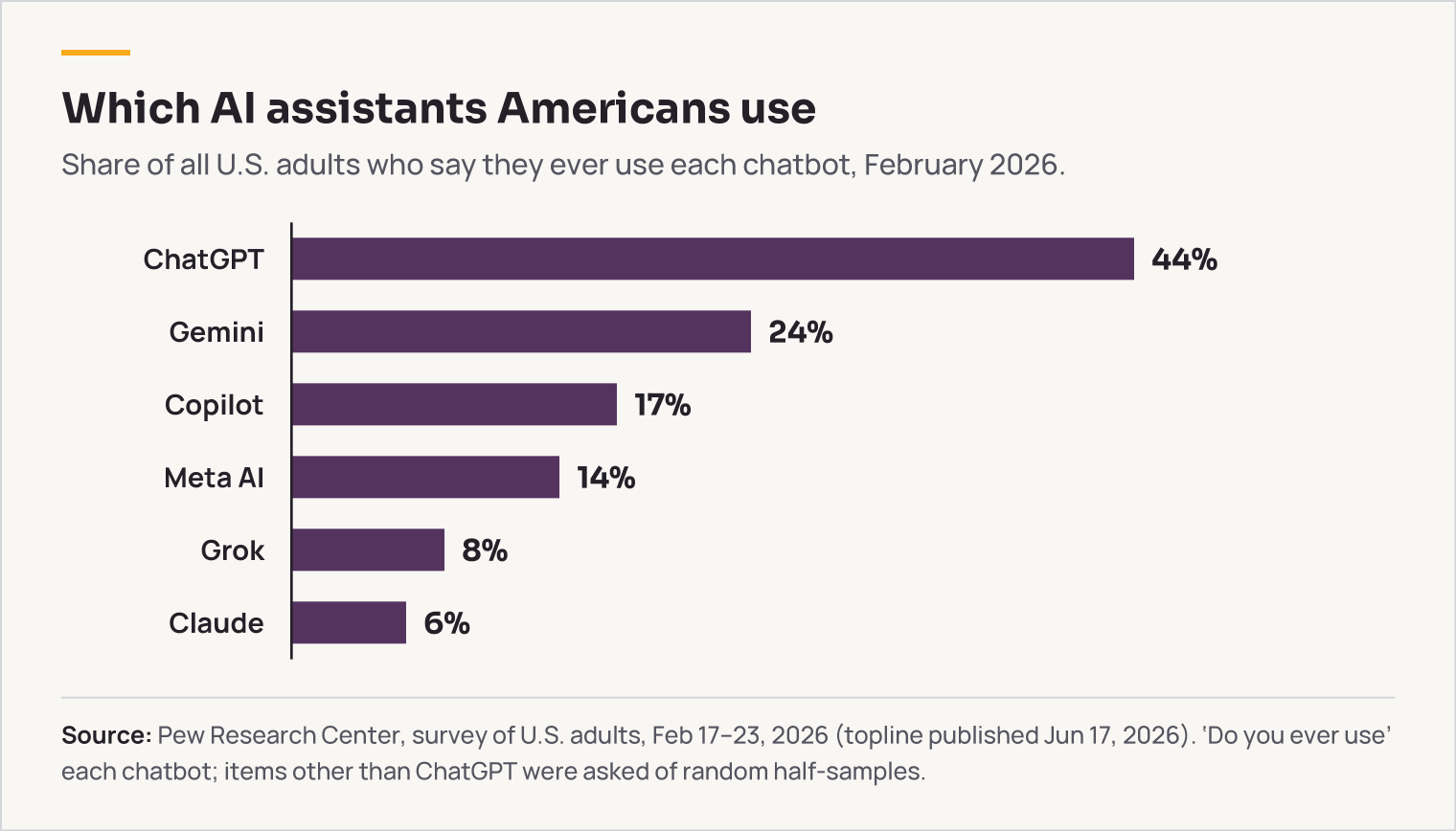
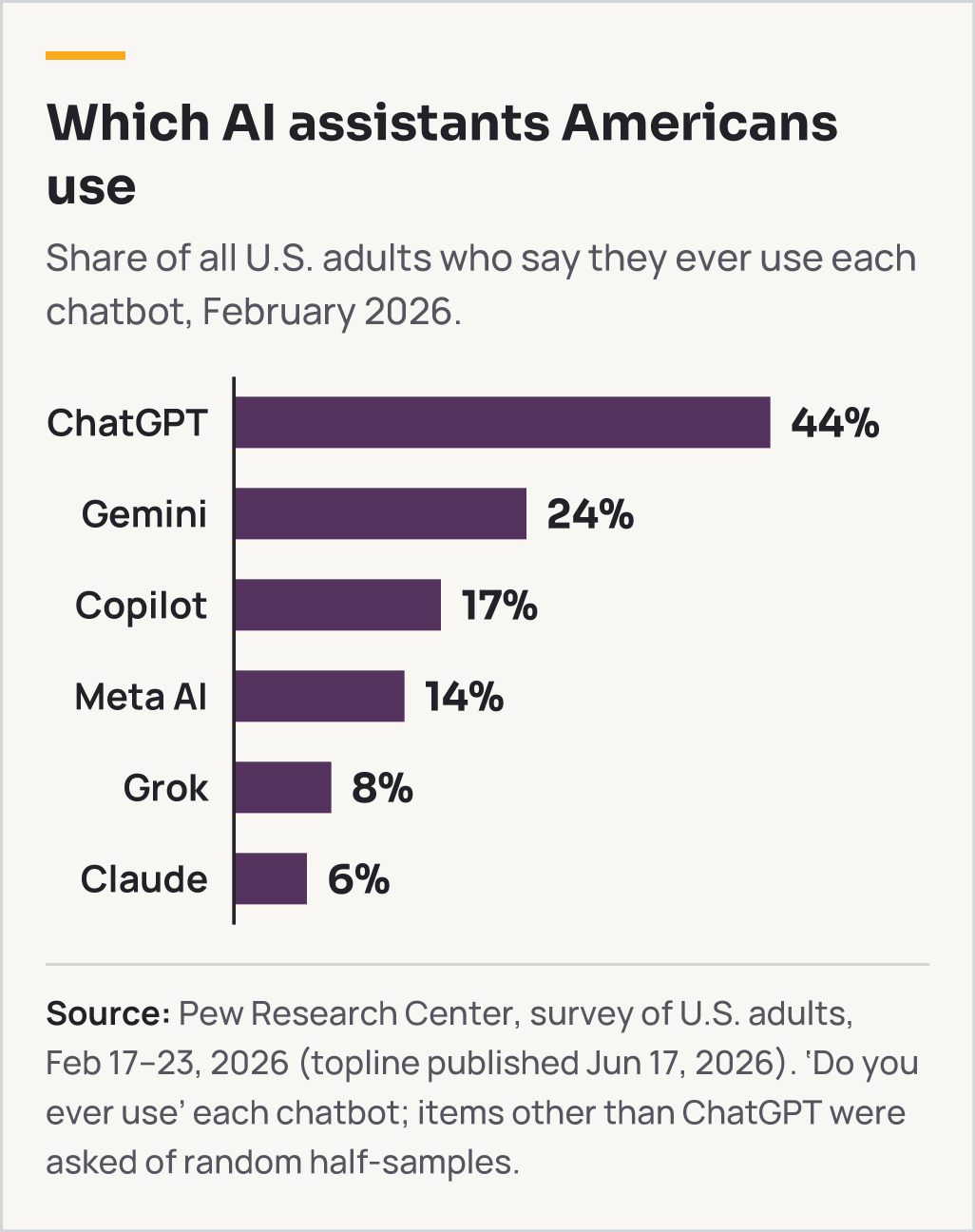
Choosing a familiar brand is easier than choosing a tool for a specific job. This comparison covers OpenAI, Google, Anthropic, xAI (whose website now calls it SpaceXAI) and Meta. Microsoft Copilot is used by 17% of U.S. adults in the Pew survey, but Microsoft has no model of its own near the top of either leaderboard used here [28] [40] [41].
The companies count users differently. Their figures stay as stated; disclosure dates are in 2026 unless noted. The other three columns measure all five on the same basis; each leaderboard uses the best-scoring model per company, not a measure of the whole company.
| Company (assistant) | Users, as the company reports them | U.S. adults who use it (Feb 2026) | LMArena text rank (votes to Sep 30) | Artificial Analysis index (Oct 6) |
|---|---|---|---|---|
| OpenAI (ChatGPT) | More than 1 billion weekly active users (Aug 31); “our collective 1.2B weekly users” (Sep 29; scope not defined) [35] [38] | 44% | #20 | 52.7 |
| Google (Gemini) | More than 1 billion monthly Gemini app users (Aug 11; “monthly users” not defined) [42] | 24% | #1 (preliminary) | 52.6 |
| Anthropic (Claude) | Not disclosed | 6% | #2 | 57.6 |
| xAI (Grok) | 117 million monthly active users of Grok features (March 2026, company filing) [43] | 8% | #34 | 46.5 |
| Meta (Meta AI) | More than 1 billion monthly actives (October 2025, latest disclosed) [44] | 14% | #8 | 48.1 |
Sources for the last three columns: Pew Research Center [28], LMArena [40] and Artificial Analysis [41].
People’s votes put Google’s newest model first on preliminary LMArena voting; Artificial Analysis’ benchmark index puts Anthropic first. Google’s preliminary lead has few votes and concerns a model with restricted access; LMArena ranks 2–10 overlap within their margins. The leaderboards answer different questions, and neither tests the exact work your team needs to do [40] [41].
Use them to narrow a shortlist, then compare tools on a task you recognize. Check the answer, the time needed to review it and whether the result improves the work. Popularity and a benchmark score are context, not a substitute for that decision.
What AI changes about being found.
A customer may now get an answer without visiting the business’s website. Google still accounted for 85% of U.S. search-engine referrals to websites in September, according to Statcounter, and Google says its AI Overviews have more than 2.5 billion monthly active users [45] [34]. The referral measure is not a count of all searches.
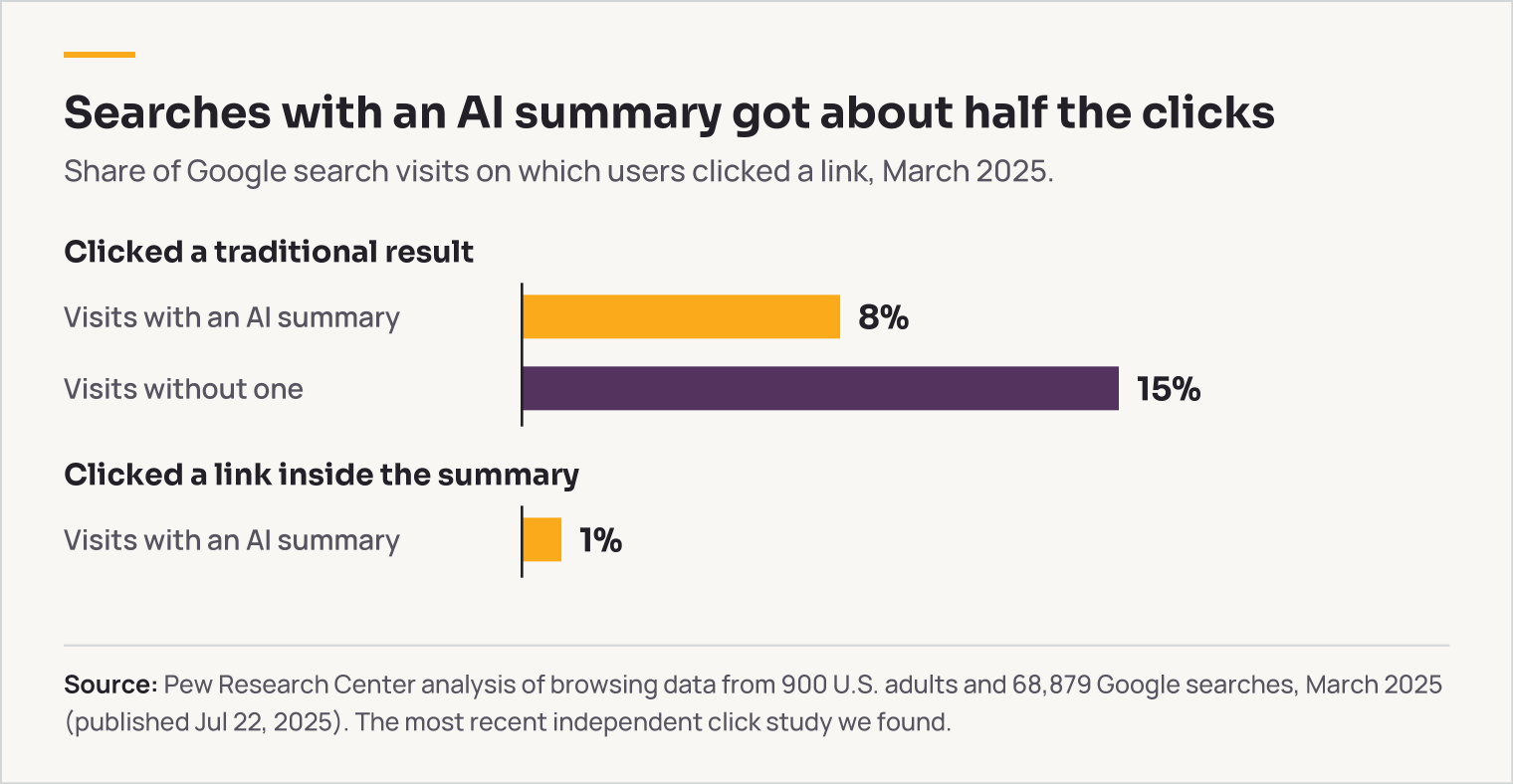
In Pew’s study of real browsing, people clicked a regular result on 8% of Google visits with an AI summary, against 15% without one [46]. The data is from March 2025, not a new Q4 measurement.
Question-style searches were more exposed: summaries appeared on 8% of one- or two-word searches, against 53% of searches with ten words or more [46]. For a business, that makes useful answers to how-to and cost questions worth considering, alongside the information a customer needs to decide whom to contact.
- 01Be findable.A complete Business Profile.
- 02Be useful.Content people find unique and compelling [47].
- 03Be measured.Search Console’s AI report for Google’s AI answers, and Google Analytics’ “AI Assistant” channel for other assistants.
AI assistants sent only 0.4% of the visits that search engines, social media and AI chatbots sent to websites worldwide in September, in Statcounter’s referral data [48]. A small click count does not settle how much AI influenced someone’s choice: a person can read an answer and leave without clicking. Keep measuring inquiries and booked work alongside visibility.
Your next move in Q4.
Choose one customer wait, one recurring task or one backlog your team can name. Write down what a better result would look like, give one person responsibility for it and set the date you will review the evidence. Keep what helps, change what needs work and stop what does not.
The research supports taking that step without promising the outcome. We found no published trial establishing a sales lift for a U.S. local service business; the strongest sales tests concern specific jobs on large platforms. You can use that evidence to choose a sensible test while letting your own results decide what earns a lasting place in the business.
Next step
Start with a business need you can name and a result you can check. Request Market Analysis.