
When lead generation stalls, I check what is holding it back before changing the plan. I examine four factors: the website, the advertising and the results reported back, the investment relative to the market and competition, and time. Even with sound work, recognition takes time and inadequate investment can hold a business back.
I developed the Lunch Line Theory to simplify how I explain lead generation to clients. I still use it today, and it also serves as a standard for where a campaign stands right now. Picture a busy lunch line where every person represents a business, and the front represents stronger opportunities to be seen and chosen. In my model, a newcomer starts toward the back, behind businesses already building familiarity and learning what produces results.
In my model, a newcomer starts toward the back, behind businesses already building familiarity and learning what produces results.
This line can reshuffle. I judge progress relative to the businesses around you, because they keep working too. An established place reflects accumulated effort, recognition and results; it still has to be supported as conditions change.
I divide the work into two halves. The first half is the foundation: it establishes the business online through its website, user experience, SEO and technical SEO. The second half is the competition: advertising, accurate tracking, returned outcomes, the businesses pursuing the same customers, and the investment. These efforts can overlap.
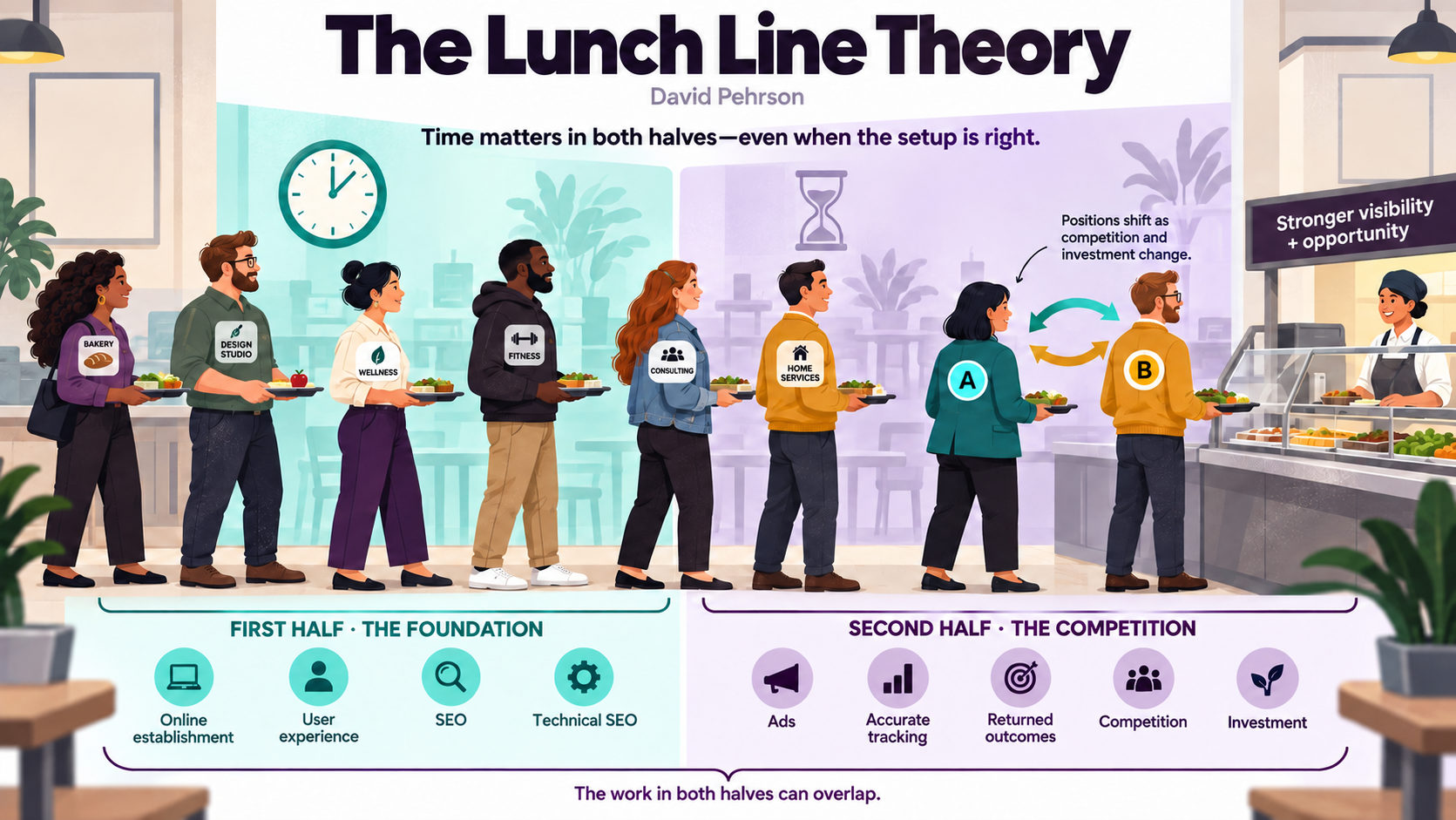
The first half: the foundation
The first half gives people something substantial to find. The website needs to explain what the business offers, who it serves and where it operates. Visitors should be able to understand the service, use the site comfortably on a phone and take the next step without unnecessary difficulty [1].
SEO and technical SEO help build that presence through useful content, clear structure and pages search engines can discover and understand. If people struggle to find the business or figure out what it provides, that holds it farther back. Bringing more visitors to a confusing experience leaves the confusion in place.
In my theory, getting those foundations into sound working order brings the business roughly halfway up the line. The remaining half asks how effectively it can attract the right people, learn from their response and make the investment worthwhile.
The second half: the competition
Advertising begins this half. The search, message and destination should fit together so the visitor finds what the ad led them to expect. Ads don’t buy organic rank, but in my experience the organic build supports the paid search ads: the visitor an ad brings in lands on a website that already explains what the business offers. The two go hand in hand.
Paid advertising generally creates earlier exposure. Both organic and paid efforts involve time, even when the setup is right: customers discover the business, familiarity develops and results come back. That time should show me what is working.
Accurate tracking shows what happened after the click, but what happened next has to come back from the business. Did an inquiry become an appointment? Did that appointment become a sale, and what was the sale worth? I want that information before I recommend more spending.
Suppose inquiries become appointments, but few become completed sales. That gives me a reason to examine the fit of the inquiries, the advertising, the page and how those inquiries are handled.
This is where the two halves strengthen each other. The website helps advertising visitors grasp the offer and decide what to do. Their responses reveal questions the content should answer more clearly. That feedback lets me improve the website and the advertising together.
Holding a place in line
Waiting still matters while inquiries develop into outcomes. When a client’s inquiries stop unexpectedly, I want to hear about it, so I can re-examine the campaign, the website and the tracking.
Market shifts belong in that examination. The offer, website, ads and tracking can all be sound while the budget remains too limited for the reach you want, because similar businesses are pursuing the same space. A budget that supported that reach before may no longer support it as competition and market conditions change [2].
That holds a business back even when the work is being done correctly. I would examine whether the investment fits the competition alongside the results it brings in. More spending should make sense for the work or sales it produces.
Near the front, businesses trade places as their execution, investment and competition change. The front is never guaranteed, so I keep checking what it takes to hold a place in line or improve it.
Where to start when progress stalls
If progress stalls, start by locating the constraint. Can people find, understand and contact the business? Are the ads bringing relevant interest, and are useful outcomes returning?
Look at market and time too. Does the investment fit the current market and desired reach? Has there been enough time for recognition and results to develop?
Those answers should determine the next move: improve the foundation, refine the advertising, reconsider the investment or allow sound work more time.
Next step
Before you raise the budget, see what your market will support. Request Market Analysis